Is Raf OK? -- Installment #239
2026-03-03 -- Jerusalem

Prior Post | Next Post | Read This Entry, #239, in Web Browser
Top Eleven IsRafOK Entries: All Time Most Viral: #234; #85; #123; #128; #140; #144; #154; #161; #164; #171; #196
Updates, Corrections & Expansions: In #238 I added the clarification that Iranian axis rockets were aimed at Israel, Saudi Arabia, and other Gulf states. I also added a note that Israel’s Homeland Defense web site requires an Israeli IP--use a VPN if outside Israel. In #238 I speculated that IAF drones over Iran implied an Israeli drone base in eastern Jordan or Western Iran. I have since discovered that Israel builds a long range drone (7,000+ km range, 30+ hour endurance), the Eitan.
My speculation is thus unwarranted.While the IAF is perfectly able to park drones in the Iranian sky for days at a time (by rotating them), in May, 2026 it was publicized that Israel did, in fact, operate a base in Iraq. More in #258.
Tags: 15+ Min Read; Very Few Videos; History! Analysis! Anecdotes!
Thank you all for the notes, questions and pushback! It is supremely helpful to hear what is going on in your respective minds. Contact me by replying to these emails or directly by email, Signal, Whatsapp or Facebook Messenger.
ICE is on many American minds. That makes sense. ICE (its motives, methods and context) is outside the scope of this blog. I observe, however, that the behavior, and goal, of ICE appears to parallel that of the Ayatollah regime’s Basij and internal security services: Instill fear and cowardice via state-sanctioned violence. That is an essential parallel and threshold.
Once upon a time (1986) I worked in Eastern Europe behind the Iron Curtain. I was told that the U.S. diplomatic orientation for scholars and cultural figures going behind the Iron Curtain included: “It is impossible for a state to police every citizen. The goal of a police state is for the people to police themselves.” (C.f. Oscar winning film: The Lives of Others and Good Bye Lenin.)
Abu Ali Express suggests:
Iran’s attacks on the Gulf countries bring back the familiar logic to the Middle East: the Shia axis and the Sunni axis.There was some blurring in the last two years, but now, the massive Iranian attacks on the Gulf countries sharpen the common denominator of the Sunni axis against the Iranians.
The October 7th attack thwarted normalization between Israel and Saudi Arabia. The Iranian attacks unleashed in the last two days may help restore the situation to its previous state.
Western Naivete
British Foreign Secretary Yvette Cooper:
We urge the Iranian regime not to attack our partners in the Persian Gulf - they have done nothing and have not attacked Iran.
The naivete is stunning. The British, of all people, should have half a clue how the tribes and countries of the Gulf feel, think and act. The British drew nearly all the borders in the region!
More below...
Mail
In Response to Raf’s Search for a Megilat Esther
No need to read the megilla, we are living it.
To write this blog, you must read a lot of news!
I read very little news, actually. News is, generally, so incomplete as to be, in effect, grossly misleading. Today’s journalists (unlike those of decades ago) are almost never educated in the topics they report on and do not have time to do research. Events are, generally, not news. Events create and exist in a historical context. That, to me, is the interesting part.
I have been a student of this region since my early teen years. (E.g. 30 or 40 years longer than virtually anyone posting on social media or reporting at CNN.) My M.A. in History focused on the Soviet Union. My mother was long a student of modern Chinese and Russian history, though her graduate degree in History focused on the Middle East (premodern times). Fun fact: Mom and I received our masters’ degrees from the same department of the same university, about twenty years apart. (I was in grade school when Mom went back to university to finish the graduate degree she abandoned when pregnant with me.)
Nothing in the Middle East started a week ago or a year ago. Nothing started or stopped because a certain President or Prime Minister was elected. The forces at work are long standing and would pressure any Prime Minister or President.
A few of the forces:
The Iranian missile development, buildup and nuclear program
The three pronged strategy [Iran, Hezbollah & Hamas] to destroy the Israeli state and murder most or all of its citizenry
The antisemitic motives cloaked as “antizionism” in far Left politics (designed by the KGB in the 1960’s and 70’s)
Accusing Israel of Genocide (also designed by the KGB)
Creation of “a-geographic” political movement known as “Free Palestine” (another gift of the KGB)
The conflict of today isn’t “America and Israel” vs. <_fill in the blank_>. That concept itself is brought to you by the antisemitic propaganda machine. Saudi Arabia, the Syrian people and the non-Shia Lebanese (among others) have been (and are) just as threatened by the Iranian axis as Israel.
The fundamental vectors are so varied and forceful, that we can all put Jews, Palestinians and Israel completely to the side and ask a few simple questions. Take Israel/Palestine completely off the table and consider:
Why would the Western World or China allow Iran to control the Straits of Hormuz, which controls 20%-25% of the global petroleum liquids supply? Iran (and its proxies) have been chanting Death to America for decades and investing money they can’t spare in offensive weapons. How long can this stand?
Ditto the Red Sea: Iran is the sole sponsor of the Houthis in Yemen, who, aside from magnifying strife in Yemen--including mass starvation and the deaths of well over a hundred thousand children from hunger--have caused massive, global economic damage with their blockade and attacks on 178 commercial vessels--each attack both a violation of international law and a casus belli [legal justification for war] in itself.
Why would the Western World or China allow a country run by religious extremists to be a nuclear weapons proliferation risk? (North Korea is a big enough wild card. Care for another?)
The U.S. was very nearly involved, directly, in Syria’s civil war. In 2011, President Obama called for Assad to resign and there was strong pressure to intervene directly. Starting in 2014, President Obama lead a multilateral military intervention which included American ground forces and nearly 20,000 airstrikes (over a handful of years). (In other words: Over recent decades, it is normal for the U.S. military to intervene forcefully.)
Saudi Arabia and a number of Gulf countries have been extremely uncomfortable with Iran’s hostility. Iran’s aggressive posture and historical grievances are the motivations behind the region’s aggressive acquisition of arms.
The Shia-Sunni fracture, perhaps background scenery to an American mind, is supremely front of mind to the entire region (and goes back over a millennium). (The Ayatollahs’ militarism and wounded pride has roots far, far deeper than American/Western involvement in Iran 50 or 80 years ago.)
None of the items above involves Israel, Jews or Palestinians. They are forces global and regional, and each one could be used by a President of any party to attack Iran, call for regime change in Iran, or both.
This War Isn’t About Bibi or Trump
The forces at work dwarf any Western term of office or political horizon. These issues are monitored and managed by career professionals in foreign offices, intelligence services and militaries around the world. Politicians (hopefully) say Yes or No, but the issues and potential responses are the work of career professionals.
Politicians take blame and credit, but it is not about them. I was impressed to see an article about the recent operation against Khamenei that (properly) credited Ariel Sharon with making Iran the Mossad’s priority in 2001, and, implicitly, acknowledges decades of work by Israeli and American intelligence professionals.
The American politicization of the war in Iran is two faced and is all noise. Gavin Newsom hasn’t sat in the White House getting calls from Saudi Arabia and the rest of the Persian Gulf saying, “Iran’s Ayatollahs are at our throats [and by extension the throat of the world’s economy], help!” And Mr. Newsom’s blame of Israel is a sad example (number one zillion) of inverting the problem and electing to be a victim of propaganda that originated at the Lubyanka (KGB headquarters). (Mr. Newsom and his team should know better--they think they are national level.)
Nahum Barnea wrote (below is a machine translation):
Since the start of the war on Saturday morning, I have been rolling two words in my head, at the end of which the question: What if? What if these two troublesome people, who deserve all suspicions, Trump and Netanyahu, are right this time? What if the attack on Iran gives rise, at a tolerable price, Iran is weakened, full of internal problems, and has much less power to harm Israel? What if in the longer term the outcome of the operation is the rise of a new regime in Tehran, freed from religious jealousy [Shia jealousy of the Sunni sphere] and expansionist aspirations, which will integrate into a new, moderate, pro-American Middle East? What if Israel is invited to be part of this vision?
Don’t fall in love with your hating, I warn myself before every column I write for the newspaper. The effort not to fall in love with hatred is what should be the difference between a columnist and a “talkbackist.” Sometimes bad politicians come to a good decision; sometimes good politicians come to a bad decision. A significant move like the war on Iran should be examined on its own.
Israel and the United States have launched a meticulous, well-stitched military preparation behind them, the fruit of months of work, and an online coordination mechanism between the American command and the IDF. The Americans came to war with their advantages; the IDF has its advantages. The coordination, one of the commanders in the campaign told me last night, had gone a few steps forward since Operation with a cabbaya in June. It’s a partnership – no one is subordinate. Israel is not a Kuwait – it does not shoot down American planes.
... Cuba has been ruled by a communist dictatorship since 1959. As every Israeli who has visited knows, the reality there is fascinating. All efforts by U.S. administrations to change the regime, by force, not force, failed. U.S. Secretary of State Marco Rubio, the son of parents who emigrated from Cuba, has been preaching for years, like Trump, to change the regime. The opportunity is waiting outside the door: After the fall of Venezuela, Cuba lost its oil supplier. The country is very close to bankruptcy. There is no need to make an effort: Cuba will fall apart on its own.
...
If these are the precedents, the future they wish for in Iran is the continuation of the existing dictatorship, with a new leadership that will be less ambitious and much more restrained: Iran 2.0. Democracy will come later, if at all. Iran has never known democracy.
Iran’s weakening, restraint, is an Israeli interest. The fatal impact on the nuclear project, the missile system and the military leadership is a bonus. The deep partnership with the U.S. military is good for deterrence: in our region, we value force. The price is a great grudge against Israel in the American public, and a great celebration for anti-Semites.
It is too early to conclude the war: We and the Americans also have a bitter experience with victory speeches that were given prematurely. It is possible to understand Netanyahu, who is trying to turn the initial success into an electoral asset. Under the auspices of the war and its achievements, the [Bibi] coalition pushes forward, with all its might, the police coup: this must not be accepted. The IDF does not fight Iran to end up with an “Iran” here: there is a limit to all tricks.
So Why Now?
I believe the history books will say that the regional evolution (which includes the massive disaster of Syria) is a result of the badly mistaken invasion of Iraq in 2003. The 2003 invasion, the multi-decade dream of a small group of American power brokers, triggered and enabled several vectors (you’ve heard some of this from me before):
Power vacuum in Iraq, which empowered and enabled Iran and ISIS
Syrian civil war, which empowered and enabled ISIS
Rise of ISIS (a derivation of which now governs Syria)
Syria’s devolution into narco-state dependent on Iran, Russia and (especially) Hezbollah
Iran’s rise during the U.S. presence in Iraq and after
American regional nearsightedness (e.g. gun shy after the Iraq fiasco)
Had the U.S. kept its “powder dry” (e.g. not invaded Iraq), that energy could have been used to either “manage” Iran’s ambitions or foster organic change within Iran. In the event, America was singed by the disaster-by-choice in Iraq and this affected its actions for many years.
Sooner or later, the burns heal. Or the clock runs out. Arriving in 2025, Iran’s missile technology is quite advanced. It’s offensive ballistic missile stockpile huge. Its nuclear program is unambiguously military in intention and the entire region is not just threatened but is being actively attacked by Iran’s proxies (c.f. the Houthis and Hezbollah).
Iran doesn’t have an air force?
Correct.
The aging 1970’s era planes of the Iranian Air Force (IRIAF) have played no role in Iranian conflicts with Israel or America. There are (or were) a few more recent Russian models. Some percent of the IRIAF were recently destroyed on the ground.
Autocrats always spend more money on internal security (read: eliminating internal threats to the regime) than general military defense. Meaning their ability to defend against foreign threats is less.
Iran specifically spent large share of its treasure, intelligence, training, and equipment on foreign violent extremist organizations. The big three are Hamas, Hezbollah, and the Houthis.
It supported Bashar Al-Assad in Syria.
Israel has spent much of the last year systematically destroying Hamas and Hezbollah’s capability to strike at Israel. The US has focused on the Houthis due to their threat to international shipping.
Assad and his government are gone. Much of their military equipment was destroyed by Israel after Assad fled.
Russia has no capacity or interest in supporting their ally due to their disastrous war in Ukraine.
One would think that Russia would supply Iran with fighters, as Iran has been a huge help in Russia’s war on Ukraine. Russia signed a deal to supply fighters in 2023, but available evidence is that none have been delivered.
Qatar
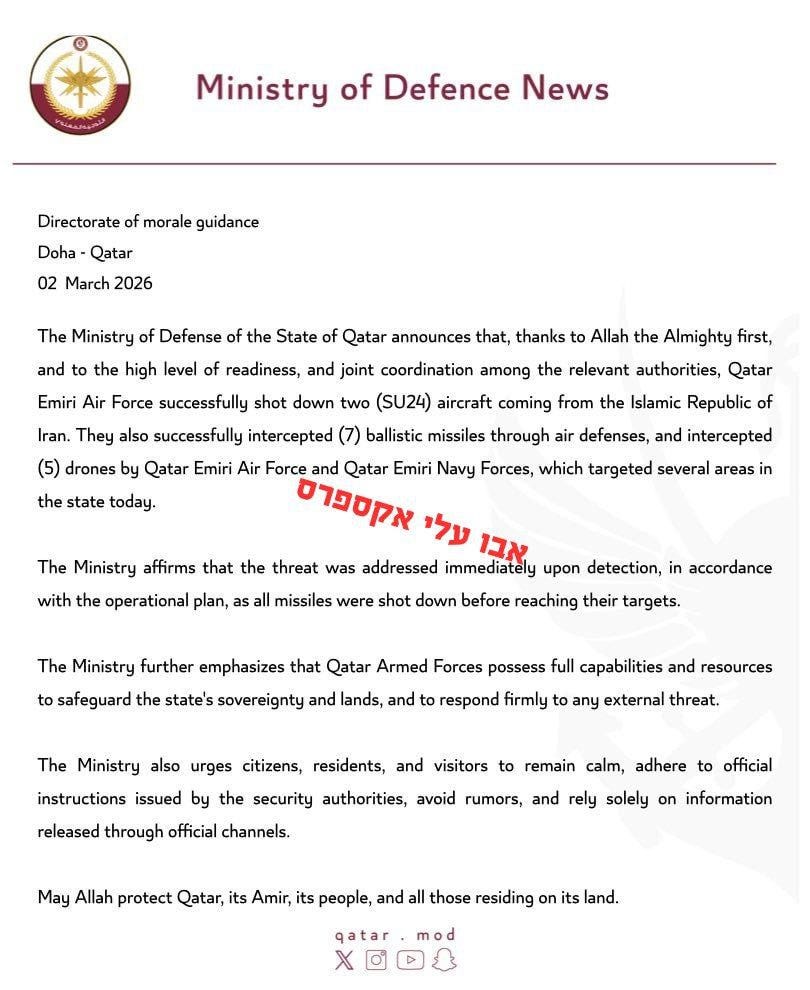
Above: Amazingly, the Qatari Ministry of Defense announced: We shot down two Iranian Sukhoi 24 aircraft.
The Qataris are shooting down Iranian jets.
Was that in your playbook? (It wasn’t in mine.)
UAE Ministry of Defense:
We intercepted 172 out of 186 ballistic missiles that were aimed at the country. 13 fell into the sea.
We intercepted 755 Iranian drones out of 812 that were identified.
We intercepted 8 Iranian cruise missiles.
3 killed and 68 wounded as a result of the Iranian attacks in the country.
Read between those lines? Are massive drone attacks being sent at Israel or the U.S. fleet? No. Iran is sending them to their neighbors.
So What Do You Think?
Judging by their actions, it appears that before the current conflict began that the Iran regime had already fallen apart.
Consider:
It took three days for Iran to announce they had closed the Straits of Hormuz. But the Iranian Navy has been destroyed. How will this play out? (Persian gulf real time traffic).
No massive launches toward Israel (Why? Because they can’t organize it.)
They shut off the internet early--very little information from the Iranian street is getting out
Only a few days into the war, and, aside from Hezbollah’s attacks on the north, red alerts have become relatively infrequent (one or two a day)
A guy on Twitter (reflecting my observations):
We are seeing a sharp, continuous drop in missile sirens in Israel over the last three days:
Sat, Feb 28: 176 sirens
Sun, Mar 1: 105 sirens
Mon, Mar 2 (As of 1819Z): 42 sirens
Given the steep rate of decline, it looks like Iran is losing its launchers at a rapid pace.
This seems to be the case. Even to the point that there is talk of reopening Ben Gurion airport on a limited basis. I didn’t expect this for at least another week.
Below: IDF footage released March 3 of IAF attacks on Iranian anti-aircraft systems and personnel:
I also think
That four weeks of war are inconceivable because the U.S. and Israel lack the munitions. I do not know this for a fact, but let’s be real: The world has been burning up munitions since 2022 when Russia’s war on Ukraine started. The IDF said 2,000 munitions were used in the first 30 hours. Stocks were low before this conflict started. I don’t see how operations at anything like this level can continue.
One data point:
Bloomberg News Agency: Qatar’s stockpile of Patriot interceptors will last, at the current rate of interceptions, for only four days.
Then what?
(A day later both Qatar and UAE denied a shortage... So what is it? Truth or honor?)
Dept of The Invisible
Items invisible/less-visible in the Western media. (Starts to the north of Israel and goes, clockwise, around the region, ending up in Gaza and then Israel. Not all countries appear in every entry.)
Lebanon
Many believe that Hezbollah’s entry into the conflict with Iran is a strategic mistake. Judgement aside, Hezbollah’s actions break the ceasefire, have nothing to do with Lebanon’s defense and invite the IDF to attack Hezbollah’s leadership (which is embedded in civilian areas).
The IDF spokesperson in Arabic gave over 18 evacuation instructions covering several areas in Lebanon.
Not things any responsible Lebanese leader would want.
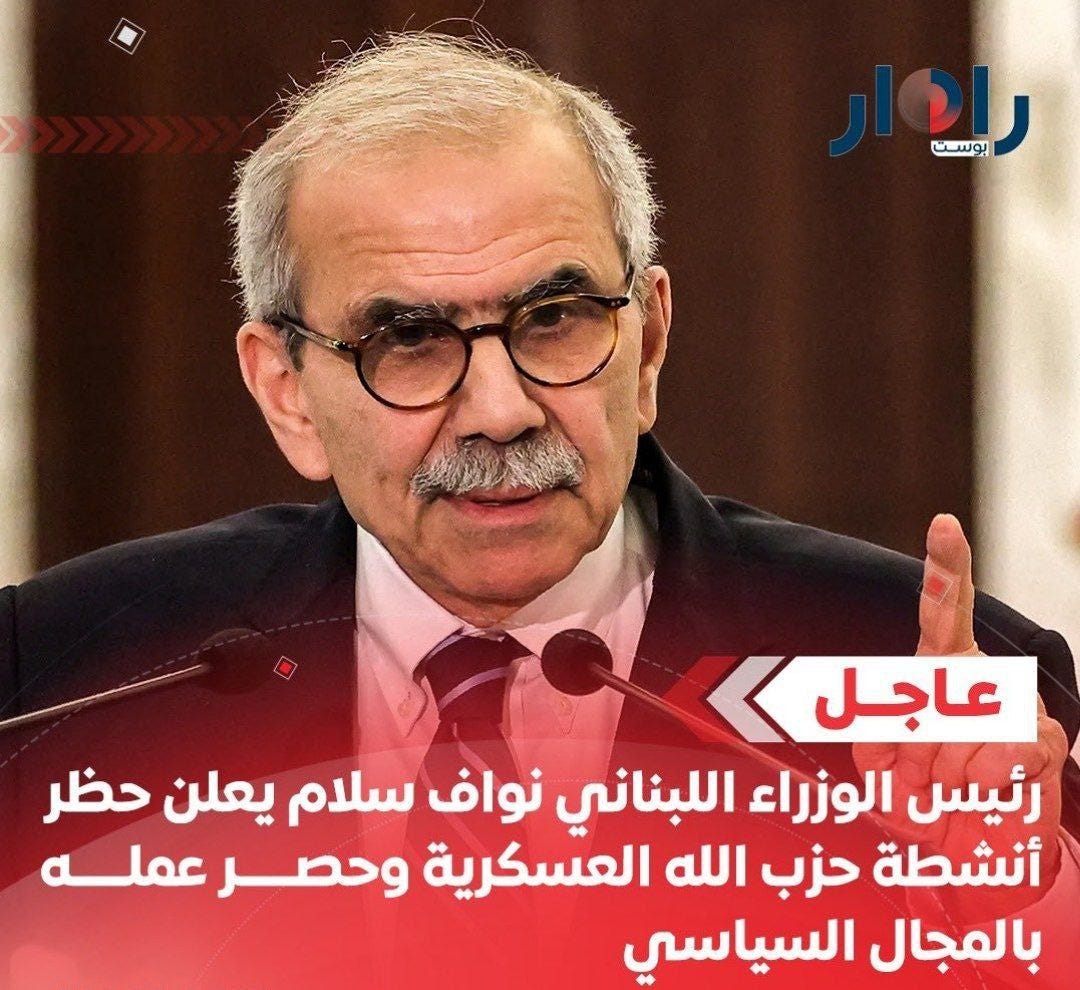
Lebanese Prime Minister Najib Salam declares the outlawing of Hezbollah’s military activity. His statement:
We declare that we oppose any military or security action originating from Lebanese territory and outside the framework of the state’s legitimate institutions.
We call on the security forces to prevent any attack from Lebanese territory.
We declare a ban on Hezbollah’s military activity and restrict its activity to the political sphere.
We declare our commitment to ceasefire and the renewal of negotiations.
We declare Hezbollah’s military and security activity illegal.
In response to Hezbollah’s rockets and drones, the IDF has been attacking Hezbollah across Lebanon and has now started a ground operation to push back Hezbollah’s drone launch sites. The Lebanese army is withdrawing ahead of the IDF.
Hezbollah’s choice to attack will, hopefully, be the last straw for it in Lebanon. I would not be surprised to see Lebanese Shia forcefully ejected from the country. Lebanon has clearly had enough.
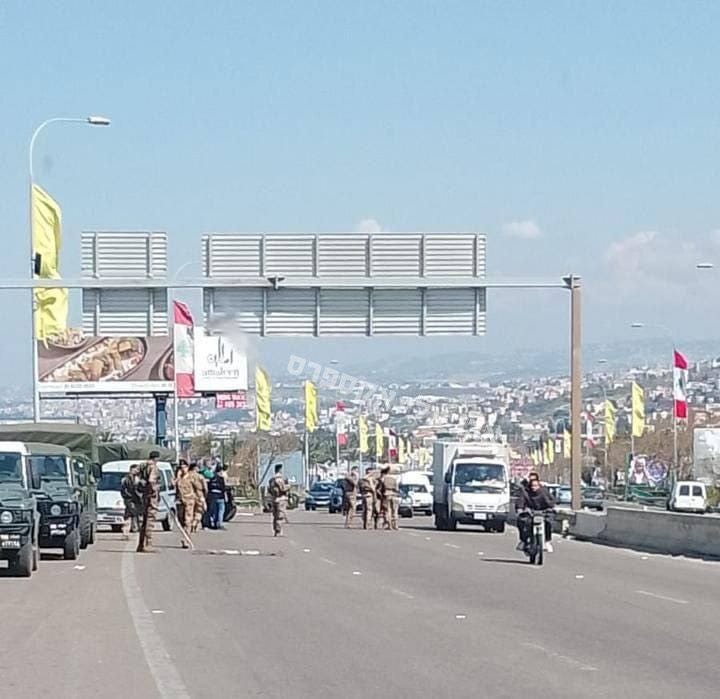
Below: The Lebanese army is trying to prevent the transfer of weapons to southern Lebanon: Lebanese channels report that the Lebanese army has set up roadblocks on the road in the Al-Zahrani area and is conducting searches in vehicles heading south towards Tyre and Nabatieh.
Iran
Iranian Deputy Foreign Minister in an interview with CNN: Iran is not responsible for the attack on the oil installations [of the Saudi Aramco company]
You cannot believe a word they say. Their denials are Soviet style: What they deny is in fact a confirmation. (The real question: Why does CNN give them airtime? And, if CNN feels they must, why does CNN not caveat the presentation, to effect: Three of the last five statements by this source were false, but here he is...) The reality, again shown today:
This morning, Iranian UAVs struck fuel depots at the Port of Duqm in Oman. Iran followed up with an attack against the Port of Raysut in Oman.
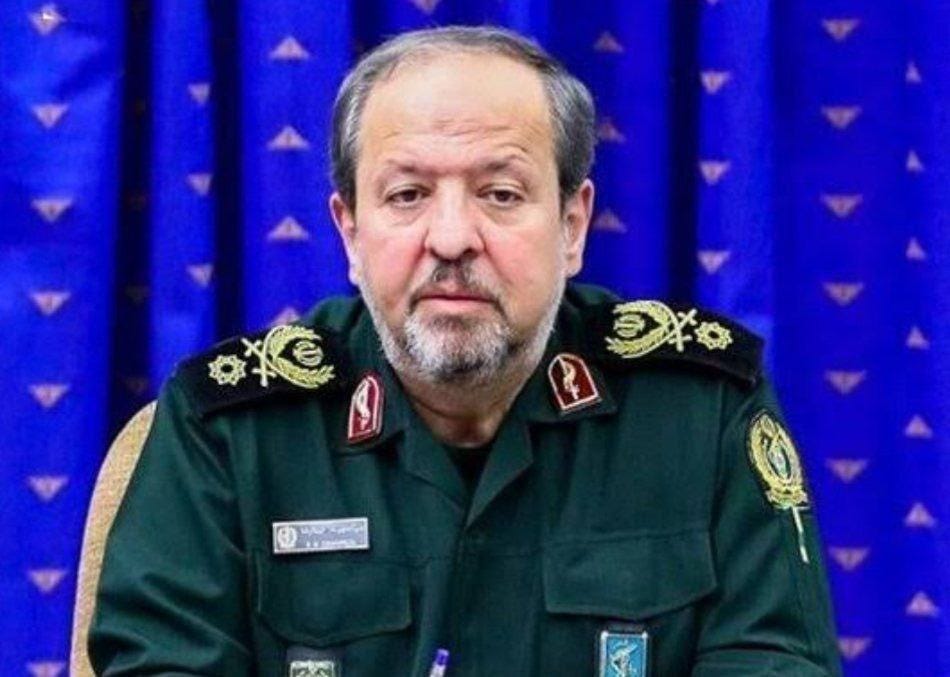
Above: Iran announced the appointment of Seyed Majid Ben Reza as acting Minister of Defense (replacing the one eliminated in the opening strike).
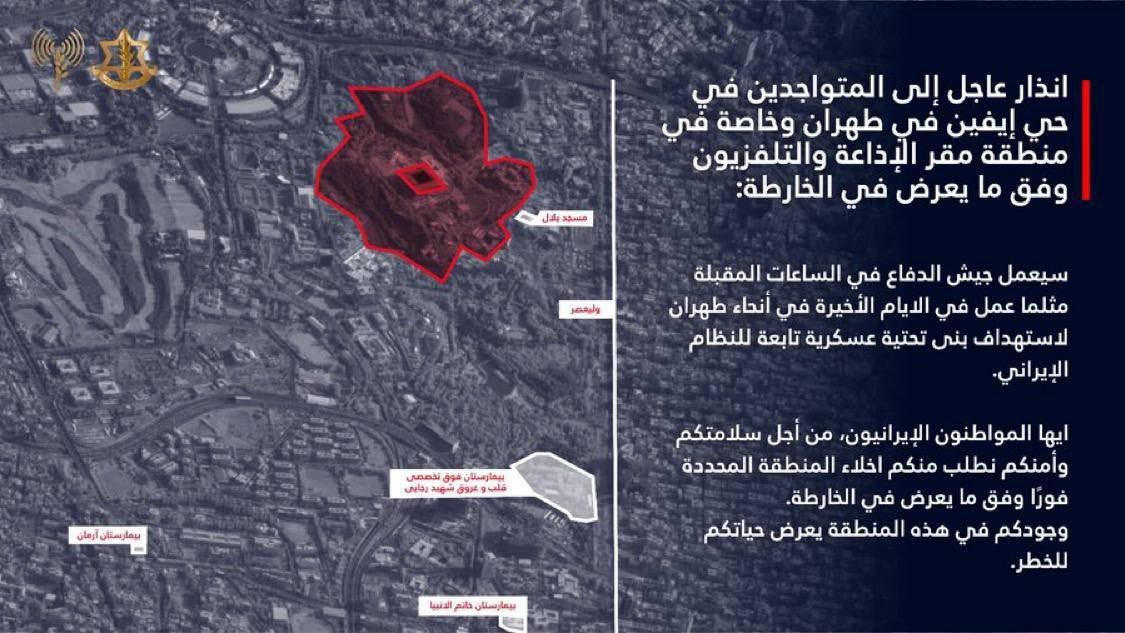
Above: IDF Spokesperson in Persian: Publication of an evacuation directive for the Evin neighborhood in northern Tehran.
In this neighborhood is the notorious Evin Prison, where the regime imprisons political prisoners.
A growing number of Israeli and American attacks have been on Basij and other branches of “internal security” (read: violent repression) on which the regime is based.
Attempted Expansion
Iran has now attacked Cyprus multiple times. These are strikes on the territory of the European Union. Add this to Iran’s strikes on civilian infrastructure in several Persian Gulf countries and what do we have?
Historically, it reminds me of Saddam Hussein’s attacks on Israel when the U.S. attacked Iraq in 1990. That was an attempt to broaden the war into a regional war. What is going on now?
Iran seems barely able to load its rocket launchers. Why is it attacking everything it can?
I surmise:
The expansion is part of a plan drafted earlier, that did not account for a dramatically weakened Iranian military; and,
The expansion is motivated by Shia honor: To paint all the Sunnis in red-white-and-blue and therefore subject to attack. This is consistent with the Ayatollah’s long standing posture (and that of Shiism generally): Everyone who isn’t Shia is somehow in league with Satan.
Dual Use
If I interpret a recent IDF announcement correctly, the Iranian regime’s civilian broadcast infrastructure was being used in parallel to coordinate the Iranian military’s missile and drone program.
Cluster Munitions
Available evidence indicates multiple instances of Iran’s missiles carrying cluster munitions, which have no military value (they can’t damage an airbase, for example), and are banned by international law.
Below: Apparent cluster munition coming down near Nablus, West Bank:
(A number of Iranian projectiles have come down in the West Bank and East Jerusalem.)
Possible Progress Report
Iranian opposition sources report:
The human rights organization “Hengaw” stated that following the bombing of military and intelligence centers of the Iranian government in the city of Mariwan, by fighter jets of Israel and the United States - just a few minutes ago all the prisoners were released from the central prison of Mariwan.
The IDF announced that a number of senior staff in Iranian intelligence, including officers who led the massacres of Iranian protesters, were eliminated in the initial attack.
There isn’t much direct content from Iran, as the regime cut off the internet at the beginning of the war (they didn’t close their schools, but they did cut off the internet--do we derive their values from their actions or their words?).
Relief Area
Alef - I only have one question...

I’m just asking... if we [Israelis] help the Iranians change their government, will they then help us change ours?
On the world turns. I was advising an American earlier to visit the marinas along Israel’s coast to find a catamaran going to Cypress.
Jerusalem is quiet. Buses are running. Shops are open. I am buying groceries and some hardware today. Though, to give a full picture, when this hit our phones this morning (news flash: In the bathroom with the water running, I don’t hear the alert):
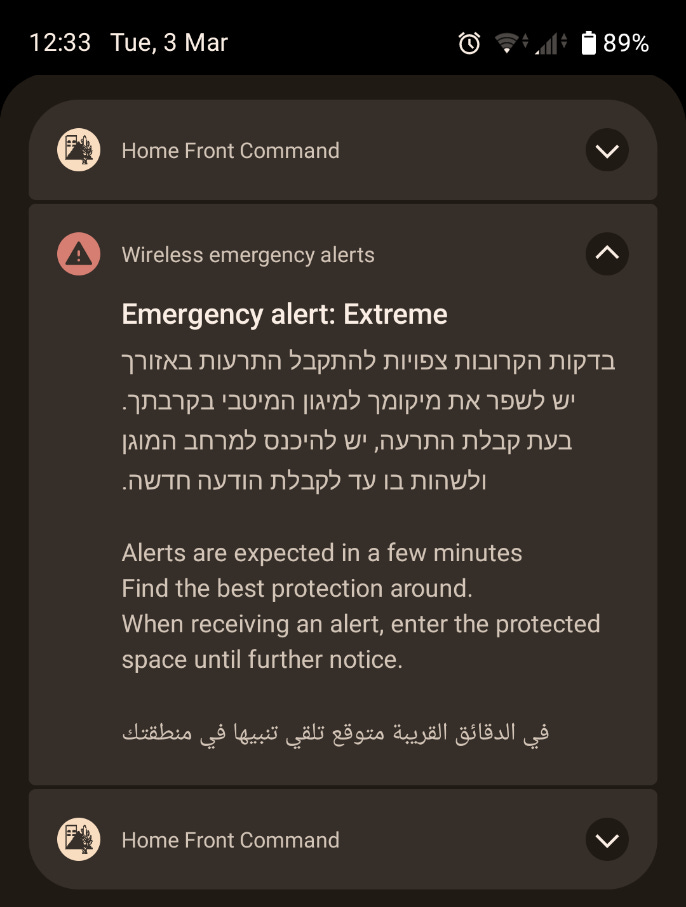
We went to the shelter:

Longer posts mean… I am spending less time in the shelter. (Just once today, so far… but I strongly imagine there will be a “Purim Surprise” some time this evening.) In the shelter this morning, we finished Winterdance. I’ve read that book three times. Maybe four now. The last line, which I never recall before I hit it, always makes me cry. (A sensitivity gifted to me by my father.)
To Peace. And a Better Iran.
Purim Sameach,
Raf
Prior Post | Next Post | Read This Entry, #239, in Web Browser
(Thank you A.K., M.T., R.G.)