Is Raf OK? -- Installment #250
2026-04-06 -- Tel Aviv

Prior Post | Next Post | Read This Entry, #250, in Web Browser
First Time Here? Readers suggest starting with the expanded Gaza Explainer in #133 and #120.
Top Eleven IsRafOK Entries: All Time Most Viral: #234; Second Most Viral: #237; #85; #123; #128; #140; #144; #154; #161; #164; #196
Tags: 8 Min Read; “Excerpt” from a future history book; Relief
Update: After email release, the Speculative History Book section had a number of minor text enhancements.
Mail
How can I send videos from IsRafOK?
What you want is the link to the entry. The videos can be too large to send (though you could download them and resend ... if you are on a laptop with the right tools).
To get the link: On a laptop, hover mouse to left of the heading. When you see the “link” button appear, click it. Now a link to that section is on your clipboard. Paste it into an SMS, Whatsapp or email…. voila!
(This may only work on the web site, not in your email app. If you are on a phone, you may need to use the “Request Desktop Site” to have this option.)
Here is a video showing how to do it:
Some additional How To Send Videos has been added to the About page.
Death Penalty Law #248
I also really liked your comments regarding the new law about the death penalty for terrorists. I am not comfortable with it because it will do nothing to deter the Jews in the West Bank from terrorizing people there, but I never thought of it in terms of all the other countries surrounding Israel that have it. So, the complaints from them are truly a double standard.... -S.D.
That Tattoo in #249’s Relief Bet
[On the beach in Michigan City] I asked her what she had on her hip tattoo, and she pulled down the top of the sarong to show me “אבה”. I’m looking at it, trying to figure out what it was (being fluent in Hebrew, it made no sense to me). When I couldn’t figure it out, I asked her what it was, and she said “it’s Hebrew”. I said I know that, but what does it mean? With her little simpering smile, she said “it means “Daddy”“. Raf, I almost ruptured my sides trying not to laugh in her face and tell her that it was spelled wrong, tattooed onto her body, in indelible ink! That’s what she gets for getting a tattoo! -S.D.
Dept of The Invisible
Items invisible/less-visible in the Western media. (Starts to the north of Israel and goes, clockwise, around the region, ending up in Gaza and then Israel. Not all countries appear in every entry.)
Rafael Grossi, Director General of the International Atomic Energy Agency: Iran has a large quantity of enriched uranium sufficient to produce several nuclear warheads.
A little less than 70% of this quantity of enriched uranium is located in Isfahan. An additional amount is in Natanz.
It may be worthwhile to recall that Iran’s agenda has been a world problem for decades. When you spend twenty minutes looking at why IAEA inspectors were in Iran to begin with (hint: inspectors are only sent when there is a extensive evidence of an NPT breach), and the publicly available data on Iran’s nuclear program and ambitions, you know what it spells?
War.
Not if, but when.
Iran was known to have obtained (with difficulty) blueprints for an atomic bomb years ago. They were known to have moved much of the R&D into university departments (e.g. out of dedicated weapons labs). Every couple of years a new, secret, enrichment site was discovered.
The problem was not small and the NPT breaches were, each of them, huge.
Iranian nuclear weapon development was a top line problem for every U.S. president since Bush Jr. For 22+ years now.
The Saudis had long said that Iran’s weapons program would lead Saudi Arabia to seek their own (one discussion from 2007).
While much grandstanding is made about the war being unjust, wrong, by-and-for-the-wealthy, etc., I can easily imagine the future’s history books reading something like this [the following a speculative section in Raf’s future history book]:
Speculative History Book: The 2026 Iran War
For decades, the Western economy, which became the global economy, increased its dependence on an energy pipeline under the de-facto control of Iran. Iran, a country with superpower ambition even after years of crippling sanctions, concluded that Western governments would consistently prioritize short term convenience (read: low oil prices) over the strategic vulnerability of energy supplies and the difficulty of challenging deeply buried components of a nuclear weapons program.
Countries of the Persian Gulf were also of two minds. They were loathe to harm their own economies, as they profited from sanctions on Iran (via higher oil prices) and again from Iran’s evasion of those sanctions (by providing banking and other services for sanctions-evasion). Gulf countries were too conflicted to exert consistent pressure to manage a huge, but so-far-unrealized, risk.
While multiple U.S. Presidents (minimally Bush Jr. and Obama) assured leaders of the region (primarily Saudi Arabia and Israel) that the U.S. would take military action before allowing Iran to go nuclear, regional leaders knew that after the Iraq debacle, the U.S. was unlikely to take direct military action. An Israeli Prime Minister is reported to have responded to President Bush’ assurances to effect, “We know America will want to, but we also know that America will serve its own needs first. Our job is to put our needs first.”
At a minimum, the intelligence services of Britain, the U.S. and Israel invested significant effort, over decades, to understand Iran’s program. This intelligence fueled a multi-decade program of sabotage and assassination, which slowed Iran’s progress by some years. In spite of numerous setbacks, Iran continued investing heavily. Both pursuing a weapon and developing ballistic missile technology.
Iran’s 2022 emergence as a key arms supplier to Russia in its war on Ukraine showed Iran militarily savvy and capable. Even under heavy sanctions it was at modern warfare’s cutting edge.
It is unclear why Iran’s role in Russia, and that war’s demonstrated effectiveness of drones against both air power and energy infrastructure didn’t trigger urgent development of drone defense in the Gulf. Both for airfields and for energy infrastructure. Similarly, Ukraine’s low-tech ability to defeat the Russian Navy in the Black Sea failed to trigger a reassessment of how the West could militarily retain control of the Strait of Hormuz.
But in all cases, from at least 2015 (and probably from 2008), pressure continually grew to use military force against Iran’s nuclear program. While this was done in June of 2025 (the Twelve Day War), subsequent actions by Iran and unambiguous messaging by Iranian leadership to the Trump administration during negotiations, showed that the nuclear threat was only going to grow. Given Iran’s unmistakable weapons ambitions, there was no known, potentially effective, option other than military force.
The 2026 Iran War showed, from its first days, multiple signs of desperation on the part of the Iranian regime: Strikes on countries across the Gulf, including on civilian sites, could only turn the entire Gulf into a sworn enemy; Invoking Hezbollah and the Houthis to engage Israel shows Iran’s inability to defend itself. To say nothing of the repeated Iranian launch of faulty missiles that only by a miracle did not cause extensive Iranian casualties.
How much of the Iranian regime survived the war is unclear, but the perspective of the region shifted: Iran’s regime is willing to take down the global economy and destroy the region’s infrastructure on its way down. This is, in effect, proof of the danger nuclear weapons pose in the hands of such a regime.
Some suggested that the war reflected immature American leadership, even to the point of saying that events were as if made by ten year olds. Aside from a perhaps unfair swipe at young children, ten year olds have potential advantages over adults: They can focus on the last piece of pie, and they know that only one kid is going to have it. They also take threats more seriously and rationalize less. Perhaps a reality like this one bothers their sleep more directly:
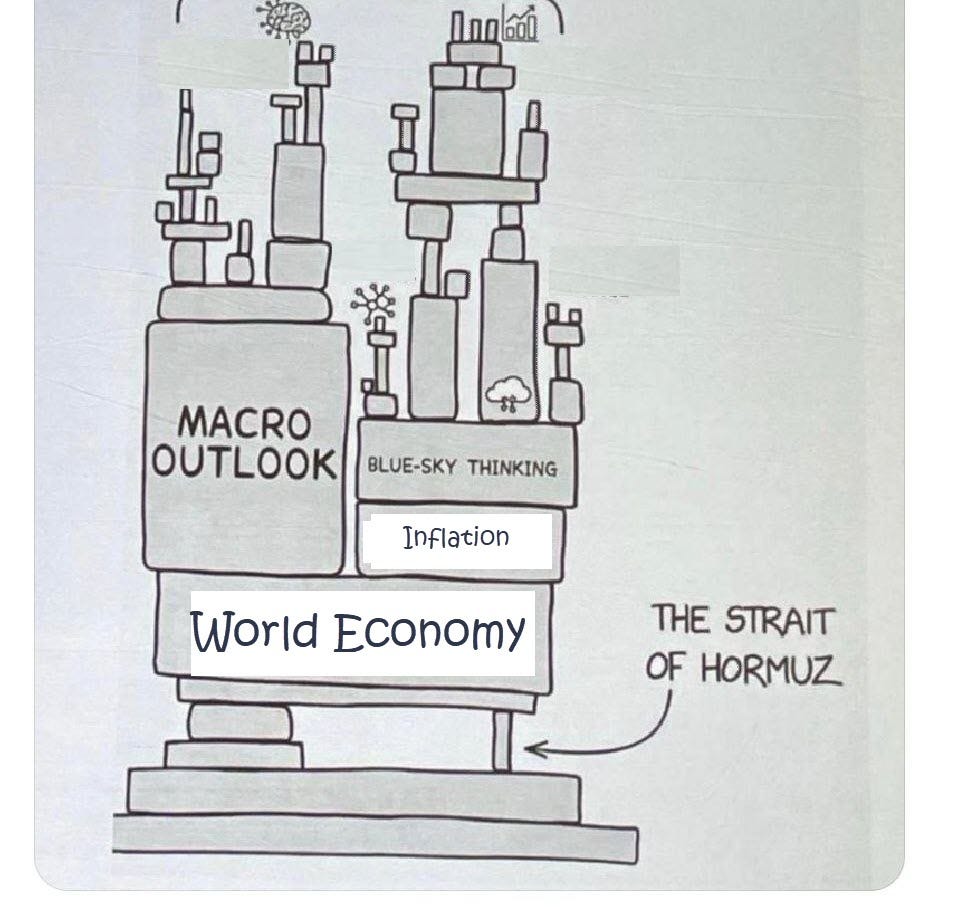
Or perhaps ten year olds would say: If Iran and Russia are the source of so many regional problems (in the Middle East and Europe), does it not make sense to deal with the smaller of the two, sooner rather than later? Or are we actually OK with all the destruction and chaos these two players cause? I mean, it’s one or the other: Either we are not OK with the chaos and destruction or we are OK with it. How many more head games do we need to play?
Observers agree that the Trump administration is the first since the 2003 Iraq debacle not be hobbled in its thinking by that fiasco. Whether this is the singular key to the outbreak of the 2026 Iran War is a matter of debate. Some scholars believe any president, of any party, would have acted the same were they free of this intellectual/conceptual baggage. Others believe the decision to attack derives from attributes specific to Trump II’s team.
This writer holds that the U.S. demonstrated (or created) something in the 2003 Iraq attack: That the North Korea model was over. That the U.S. would take military action to prevent proliferation. That the 2003 Iraq invasion was a debacle built on a Big Lie masks this postural evolution. In the 1990’s, it is reported that only President Clinton’s threat of military action (backed by visible military staging) paused North Korea’s nuclear weapon development. It is a short step from that experience to concluding that Samantha Power’s proposed doctrine has actually been internalized and activated in the halls of American power (though perhaps not in quite the form Ms. Power envisioned). This Samantha-Power-Adjacent doctrine is: The U.S. will use military force to prevent WMD in the Middle East.
Iraq
A militia claims responsibility for attacks from within Iraq on neighboring countries
Until now, the Shiite militias in Iraq have claimed responsibility for attacking (usually American) targets within Iraqi territory.
The Shiite militia Saraya Awliya al-Dam claims responsibility in a video released by them for attacking targets in Syria, Jordan, and Kuwait using suicide UAVs.
Operatives of the militia loyal to the Shiite axis operate from Iraqi territory, in uniform, and it is likely that they are funded by the umbrella organization Al-Hashd al-Shaabi—which receives Iranian funding.
This is grounds for the attacked countries to declare war on Iraq (though they will probably do nothing about it).
Raf can’t even tell if the video is real or AI. Though it does not matter, as the attacks are happening.
Iran
Greying Leadership?
I asked in #249--Is the entire Iranian leadership a greying bunch from the 1979 revolution?
April 6:
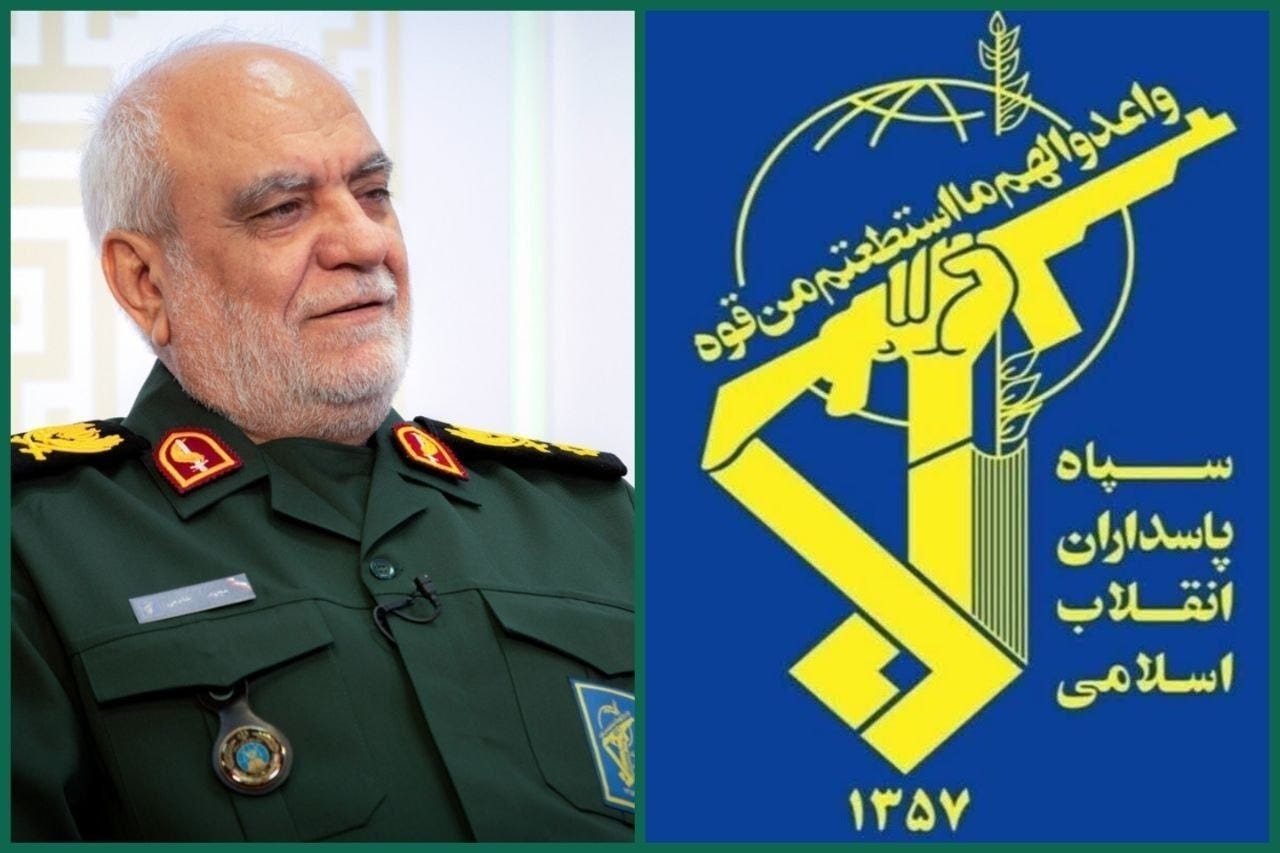
The Iranian Revolutionary Guards admit: Majid Khadami, head of the intelligence division of the Iranian Revolutionary Guards, was eliminated.
Gulf
The vast majority of Iranian munitions are directed at countries of the Gulf. Why nearly zero footage of the damage?
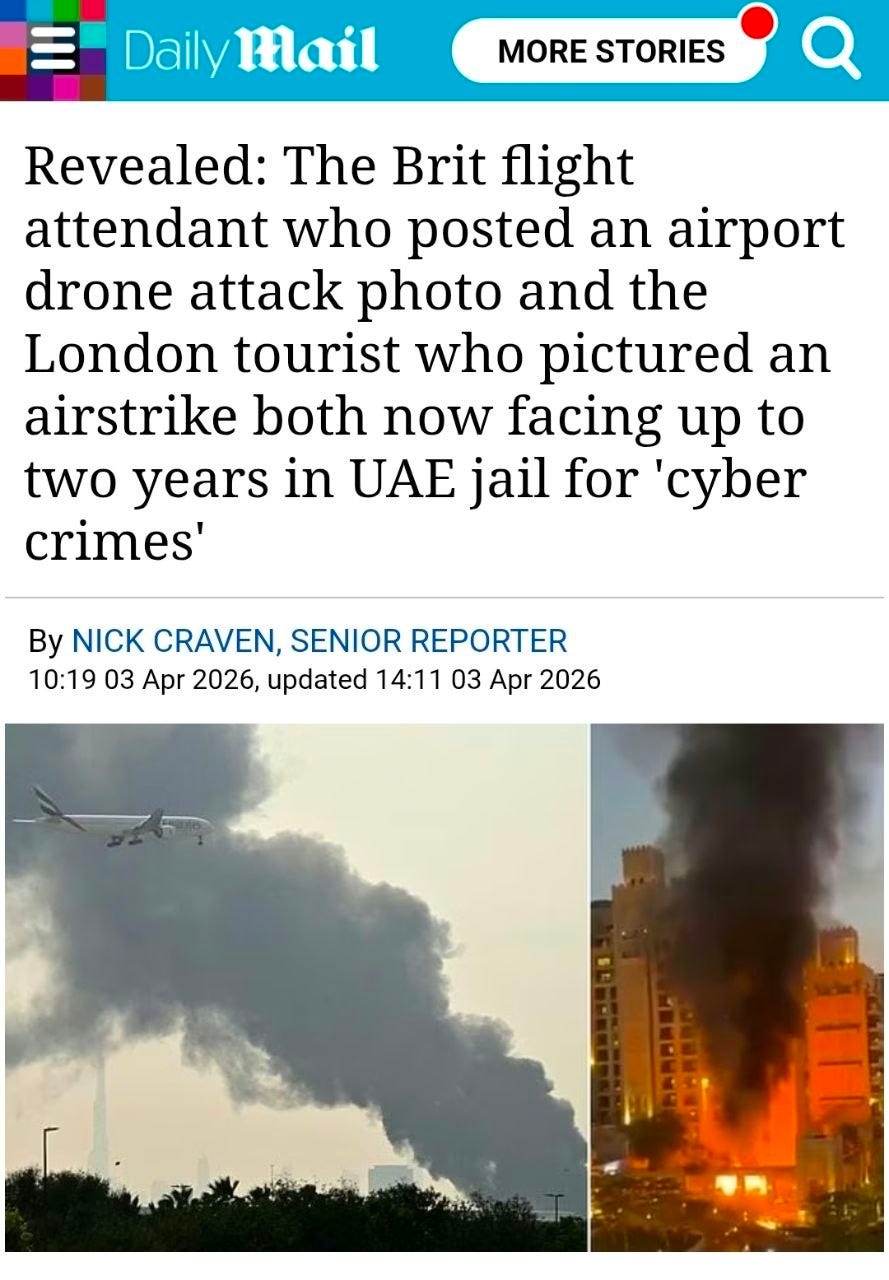
The British Daily Mail: Close to 70 Britons are detained in the United Arab Emirates for photographing and publishing images of impact sites and locations attacked by Iran within the UAE.
One of the detainees is a British flight attendant who posted a photo of a UAV strike at the airport to a private WhatsApp group and asked his friends in the group: Is it safe to pass through there?
The detainees could be sent to prison in the UAE for up to two years and fined up to about 50,000 euros.
According to estimates, more than 160 people are detained in the United Arab Emirates for publishing documentation from impact sites.
Voices
I don’t love John Bolton. But I recognize that when it comes to warfare, he has a solid historical foundation.
A couple of points from a recent essay of his:
There is no need to occupy Kharg Island. Far better instead to blockade the strait and allow no Iranian oil out until all Gulf oil can transit safely as well.
…
Our strength and leverage over events in Iran are growing, not diminishing, and that strongly argues for maintaining a strategic perspective rather than responding to oscillating economic or political pressures, notwithstanding the loss of two American planes on Friday. Mr. Trump should continue destroying Iran’s instruments of state power, primarily the Revolutionary Guards Corps and its subsidiaries that threaten America and its allies (the Quds Force) and the Iranian people (the Basij militias).
…we should not create any more self-imposed deadlines but should instead pursue more targets at a rate of our choosing, especially searching for nuclear manufacturing sites and storage facilities we have missed to date. Ongoing military attacks are the best way to continue to thoroughly destabilize the regime, allowing Iran’s opposition and potential defectors to exploit its crumbling authority and, with persistence and some luck, eventually collapse it.
[Note the reference to “self-imposed deadlines.” From a negotiating perspective, Trump’s announcement of deadlines is self destructive as it leads to negotiating with yourself. Deadlines only work when the other party is actively at the table. This is negotiating 101. -Raf]
Israel
Shalom Achshav (Peace Now) Says:
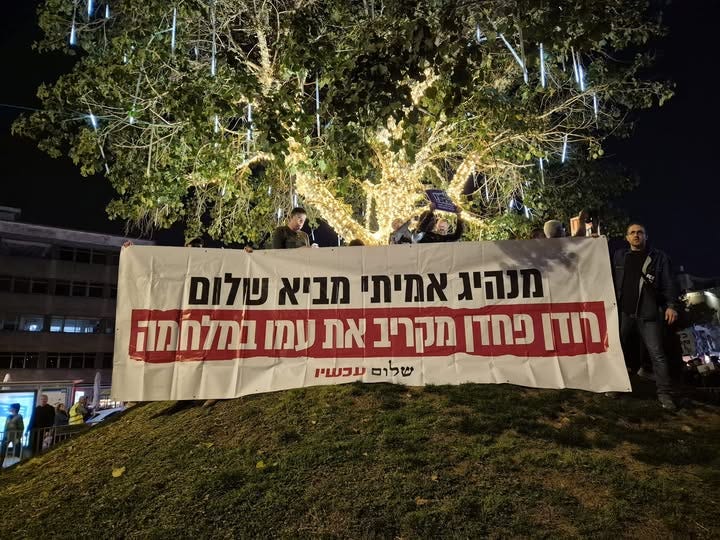
A real leader brings peace
A cowardly tyrant sacrifices his people in war
Relief Area
Alef - Under Missiles: Ancient Artifacts & Modern Art @ The Israel Museum
9 Min, English Subs
Bet - Yohay Sponder
1 Min, in English
Gimmel - In The Tree, Holding a Key Called “Hormuz”
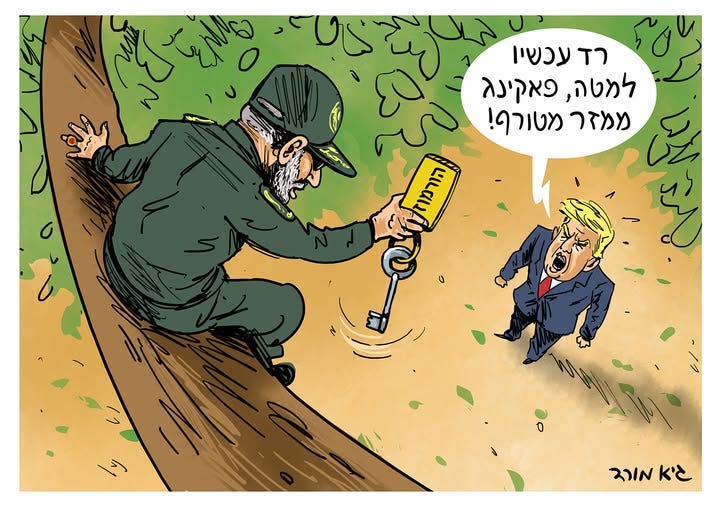
Get down right now you fucking crazy bastard!
Welcome to Tel Aviv:
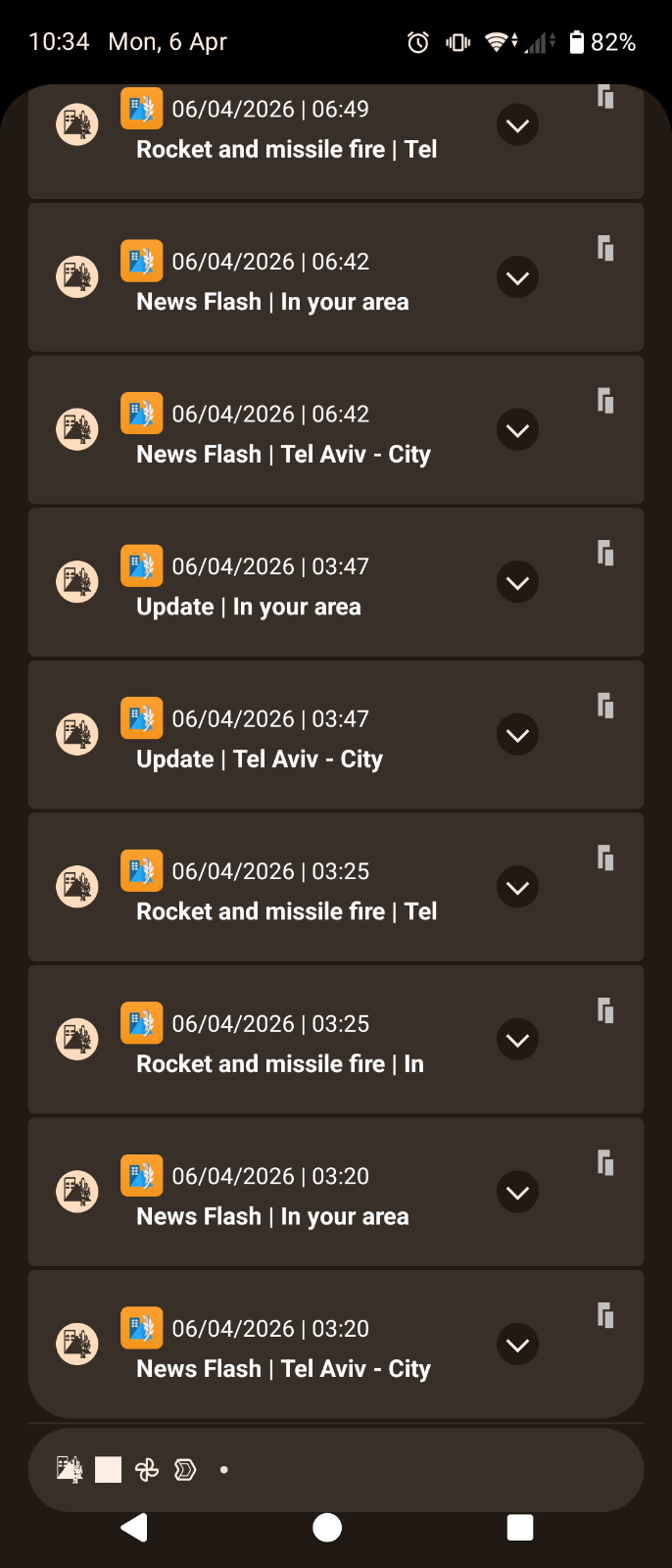
I came back to Tel Aviv for a few days. The Passover Seder was... fine in Jerusalem but several-times-interrupted in Tel Aviv.
I have been in various shelters since I’ve been here. Including the basement of a health food store.
To Peace. And an improved Iran.
Raf
Prior Post | Next Post | Read This Entry, #250, in Web Browser
(Thank you A.K., M.T., R.G.)